
Arcada at EMS2025 conference in Stockholm
Published : 20.11.2025 / Publication / Blog
For three days, the front dock of the Waterfront Congress Center in downtown Stockholm swarmed with Swedish ambulance units, splashing blue lights onto the high center walls like an urban art show, while emergency professionals walked in and out at a brisk pace. The EMS 2025 congress filled the center halls with sessions on around emergency care, keynotes from Lee Wallis of WHO, and Sofia Iveslätt of Medicines sans Frontiers, who highlighted the need for basic education and working in war-torn areas.
The EMS (Emergency Medical Services) congress has been organised since 2016 by the European Association for EMS , shortly EMS Europe. This year in June 2025, EMS 2025 was the biggest congress in Europe for emergency care and emergency medical services professionals, with key themes including patient safety, quality improvement, advances in resuscitation science, trauma care, and disaster preparedness. For three days, the front dock of the Waterfront Congress Center in downtown Stockholm swarmed with Swedish ambulance units, splashing blue lights onto the high center walls like an urban art show, while emergency professionals walked in and out at a brisk pace. The EMS 2025 congress filled the center halls with sessions on around emergency care, keynotes from Lee Wallis of WHO, and Sofia Iveslätt of Medicines sans Frontiers, who highlighted the need for basic education and working in war-torn areas. E-poster stands ran oral presentations while the hottest industry innovations by Laerdal, Zoll, Falck, Corpuls, Stryker and Heartrunner filled the venue. Swedish ‘fika’ was ever-present, topping it off with a fantastic gala dinner at Stockholm City Hall Blue Hall, best known for the Nobel Prize Banquet. Over 1,200 participants from all around the world attended; all Nordic countries, most European countries, the UK, US, some Asian countries, and even Australia was represented.
Arcada University of Applied Sciences was represented by three members of the emergency care faculty team: Christoffer Ericsson, Niko Loimijoki and Hannes Similä. Christoffer had the honor to act as an evaluator and judge in the European EMS Championships , a competition based on country-representing clinical teams performing in simulated scenarios, culminating in a mass casualty sightseeing boat accident on the main stage. The winning team this year was Austria.
The Arcada faculty team also presented three posters. Christoffer Ericsson, Degree Program DIrector for EmergencyLead programme, presented a poster on the Kids Save Lives project in Finland, describing how the project was organised since its conception in 2022, allowing for scalability across Finland with continuously increasing interest in professionals and schools to be part of the project. CPR training programs for school children have shown long-term effectiveness in increasing lifesaving skills [Schroeder et al, 2023]. Arcada has been one of the main planning organisations in Kids Save Lives since its start, together with the Finnish Resuscitation Council. A hierarchical project structure was conceived and implemented, with local Kids Save Lives educational centers, i.e. universities, hospitals or nonprofit organisations with affiliated healthcare professionals, formed to recruit local schools and educate schoolteachers (4 hours) in lifesaving skills and attitudes. According to a review by Mollo et al [2024], teachers show equivalent results, compared to healthcare professionals, when training CPR skills to school children. Finnish teachers thus train their school children 3 hours annually, embedded into existing courses and utilising ready educational KSL material. Results, based on admittedly non-reliant self-reports from participants, show over 400 schools have enrolled since the start, with over 800 teachers acting as educators and 15 Kids Save Lives educational centers nationally organised locally (these numbers are probably much higher due to lacking self-report data). This indicates that implementing a resource-effective national Kids Save Lives system with scalability potential is possible, utilising a hierarchical project structure, shared responsibilities, pre-made material and collaborating with healthcare professionals, schoolteachers and industry partnerships.
Further representing JEDI in EMS, a Nordic research group GENUS (Gender in Nordic AmbUlance Servies) project, Christoffer also presented a descriptive poster on the gender distribution of paramedics in three Nordic countries (Finland, Sweden and Norway). The results of register-based studies from open data sources showed a clear longtime increase of females within paramedic graduates and professionals. In Norway, official statistics on gender distribution of paramedic students showed that female BSc Paramedicine graduates increased from 37,5% (n=12) to 64,4% (n=29) between years 2017 (first Norwegian BSc graduates) and 2024. In Finland, female Emergency Care bachelor student graduates increased from 25% (n=60) to 64,6% (n=390) between 2002 (first graduates) and 2024. In Sweden, between 2010 and 2023, an increase from 49% (n=72) to 71% (n=165) female ambulance nurse was noted. This highlights the need for education and work life to recognise this change. Future research should also focus on exploring the extent to which both genders perceive real career opportunities in EMS. Examples of such could be supervisory, managerial and/or incident commander staff.
Niko Loimijoki, Degree Program Director for the Emergency Care programme, presented a poster on a training module focusing on tactical resilience, an adaptation of resilience engineering [Loimijoki 2023]. To date, 115 bachelor level paramedic students have participated in the training while studying in the emergency care programme at Arcada UAS. The module encompasses theory on team resilience, cognitive decision making, and identifying and managing stress reactions, needs emerging from the inherent uncertainty and complexity of prehospital emergency care work. In addition to theory, the training module consists of non-contextual group exercises and simulation scenarios designed to introduce some clinical or non-clinical challenges to overcome utilising learned resilience skills. According to feedback gathered from participants, the simulations were perceived as challenging, but psychologically safe, engaging, ang meaningful.
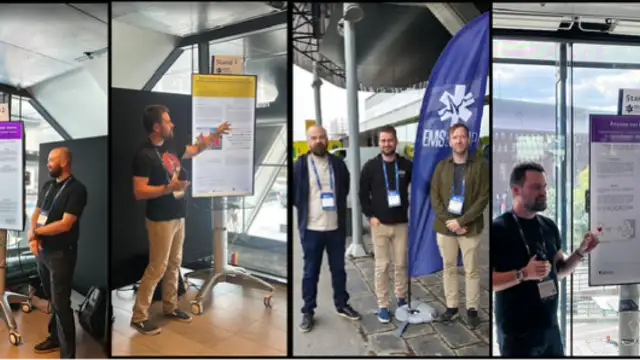
As the blue lights in the front yard of the Waterfront Congress Center dimmed and people started shuffling back towards their homes, one is left with the prevailing thought that EMS today needs this. We cannot be constrained by our ambulance walls and the hard clinical work we perform there within, and we shouldn’t be blinded by all the tech and innovations thrown at us from all corners. We, the authors, would like to thank EMS Europe for organising this great and inspiring conference in the beautiful city of Stockholm. Participation in EMS 2025 was made possible through external financing by Svenska Kulturfonden, whom we would also like to sincerely thank.
Christoffer Ericsson, PhD, Degree Programme Director of Emergency Lead Master’s Programme
Niko Loimijoki, MHc Emergency Care, Degree Programme Director of Emergency Care
Hannes Similä, MPed, BHc Emergency Care, Senior Lecturer in Emergency Care
Källor
Loimijoki, N. (2023). Learning resilience skills through simulated scenarios. [Master’s Thesis, Arcada University of Applied Sciences]. Theseus. https://www.theseus.fi/handle/10024/800845
Mollo A et al. (2024). Kids save lives: Who should train schoolchildren in resuscitation? A systematic review. Resuscitation Plus. 2024 Aug 29;20:100755. doi: 10.1016/j.resplu.2024.100755. PMID: 39282501
Schroeder, D. C et al (2023). KIDS SAVE LIVES: Basic Life Support Education for Schoolchildren: A Narrative Review and Scientific Statement from the International Liaison Committee on Resuscitation. Circulation, 147(24), 1854–1868. https://doi.org/10.1161/CIR.0000000000001128
Health and Welfare
Welcome to the Health and Welfare blog where Arcada researchers, teachers and students write about topics related to education, research, development and innovation at Arcada.
