
When the system bends: applications of resilience engineering in emergency care
Published : 06.11.2026 / Publication / Blog
Emergency care rarely fails in one single dramatic moment. Far more often it works, shift after shift, because someone quietly adjusted: a nurse reordered her tasks, a dispatcher sent a closer resource, a paramedic reassessed what the patient needed next. This is the premise of Resilience Engineering, and it is the starting point of one of the core courses of our master's programme, Emergency Care Systems Development and Leadership.
In this post we will explore what Resilience Engineering is, why it matters in emergency care, and, using examples from the course, showcase how Resilience Engineering can make sense of real situations from practice and experience.
What do we mean by “resilience”? In our contemporary times and discourse, this term is strongly trending. However, it often lacks clarity and focus, being tossed around as a broad term. This blog post thus intends to explore what resilience means in the context of emergency care, and healthcare in general. It will do that through the theoretical lens of Resilience Engineering (RE), a framework that grew out of the field of safety science, with Professor Erik Hollnagel being its primary voice. According to the RE framework, resilient systems can respond to what happens, monitor what is or could become a threat, learn from experience, and anticipate what may come. (Hollnagel et al, 2011) It should be noted though that resilience is not a virtue to be extracted from staff.
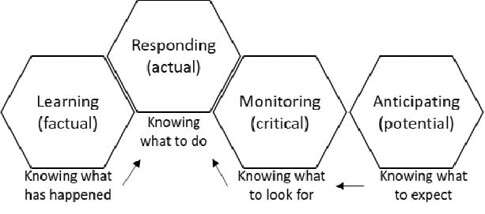
Picture: The cornerstones of Resilience Engineering, RE (Hollnagel et al., 2011)
One central shift that RE takes is to change the question we ask about safety. The “traditional approach”, Safety-I, defines safety as the absence of accidents (Hollnagel, 2014), asking why things went wrong. In contrast, Safety-II asks why things usually go right, given how variable, under-resourced and unpredictable everyday work is (Anderson et al., 2020; Hollnagel, 2014). This distinction is valuable for understanding resilient work, as failure is seldom attributed to one single source, person, or moment.
Emergency care, both in hospital and prehospital, has features that make resilience a practical necessity rather than an academic nicety. Demand is variable and cannot be scheduled. Time pressure is real, and delays compound. The parts of the system are tightly coupled: an ambulance that cannot offload patients into the emergency room, a ward that cannot accept a patient, or a department with one physician all create pressure somewhere else. Add the realities facing many health systems today, such as workforce shortages, financial restructuring, crowded departments and ramping at the hospital door, and the system is routinely asked to deliver the same output with fewer resources than planned.
We will explore Resilience Engineering using some examples below. These are loosely based on written course assignments from one of the core courses, Emergency Care as a Dynamic Systems (5 ECTS), in our master’s degree programme, Emergency Care Systems Development and Leadership. These individual essay assignments asked students to reflect on the practical use of Resilience Engineering in emergency care, using examples of failure or systems challenges in their own contexts. While they are not research findings, these student descriptions showcase how the RE framework behaves when it is applied to real practice. Descriptions below have been revised so as not to be identifiable.
The work we plan, and the work we practice
In our daily work, things like procedures, plans, guidelines, and pathways describe how work is supposed to happen. Our supervisors, managers, and even ourselves often have an “idealised” image of how our work looks. This perspective is known as work-as-imagined (Hollnagel et al, 2015). In contrast, what actually happens in the moment (i.e. work-as-done) is shaped by who is on shift, other ongoing competing activities, what resources are available, and the small correcting decisions we make. (Hollnagel et al, 2015). Therefore, the gap between these two (work-as-done vs. work-as-imagined) is not primarily a sign of people knowingly or blatantly breaking rules or regulations, but a feature of complex systems, a part of the adaptability of professionals. In other words, a part of resilient behavior. (Hollnagel et al, 2015).
The gap between planned and practiced work appeared in almost every student description, and each time it hid something different. On a ward, the plan assumed six nurses for twenty patients. In practice four or five coped by protecting medication and urgent care and letting documentation and less urgent tasks wait. The key point was that an empty bed is not capacity: capacity is a bed plus the staff to care for the person in it. In another student essay, a pathway that looked coherent on paper (emergency call, nearest department, specialist unit) did not match what the department could actually provide. In a prehospital description case, a reduction in units justified by falling call volumes ignored how demanding calls were and how driving times had changed. Those making the plan and those doing the work were looking at different pictures.
Adaptability as local rationality and drift to failure
In none of the student descriptions a direct culprit was found. An operation theatre nurse who manages the end of one operation and the preparation of the next without calling in a backup colleague is weighing workload, travel time, fatigue and how that colleague might feel about being called. Another prehospital case traced rational decisions at every level, from the funding body to local management.
Adaptability is the result of professionals, experts and novices alike, who make decisions based on their current knowledge, the perception of what they are trying to achieve, and what pressures they face at the current moment. This is known as the local rationality principle (Hollnagel, 2009). A decision that looks inexplicable in hindsight (like a nurse not calling for backup) usually makes more sense from where the person stands at that moment. In addition, professionals in emergency care are often forced to make constant trade-offs between being efficient and being thorough (Hollnagel, 2009): patients need to move through assessments, treatments, handovers, and discharges, but without compromising patient safety.
In every student description, adaptation kept things going, but it was rarely visible to those further up the chain. This mismatch is also mirrored in a study by Sujan et al. (2022). A shift on the ward that ends without an incident can look like success while hiding how close to the limit people were working. The operation theatre student description noted earlier also added to the danger of success: coping alone usually works, so it gradually becomes normal while safety margins shrink. In other student accounts, ambulance crews took on more calls while the organisational picture of their work lagged behind. In most descriptions, system pressure was displaced rather than removed: a declined ward admission loaded neighboring wards and eventually the emergency department, and in one description the burden ended up with the patient, who had to make the next call and the next journey. Such phenomena are also noted in works by Sujan et al. (2022), and Wears and Perry (2019). Resilience achieved this way is not the kind we want to celebrate. Instead, this is what Dekker (2011) calls drift, a gradual, incremental decline into potential disaster, driven by environmental pressure, unruly technology, and social processes that normalise growing risk.
Another student case describing a rural cardiac arrest showed a system working as designed. A neighbor, a local first-responder unit, an ambulance and later a HEMS (Helicopter Emergency Medical Services) unit each compensated for the others' limits, and the plan itself anticipated distance by including closer resources. Yet the description was candid that this compensation only works if the alternatives are available to use. With several simultaneous emergencies, there would be little room left to compensate. The same applies to the backup colleague in the operations theatre case. Efficiency measures that remove this form of slack consequently make adaptation harder and leave the system more fragile than its normal performance suggests (Hollnagel, 2011). In this current age of continuous austerity measures and budget cuts, such impacts on systems resilience should be considered, especially for societal safety functions, such as emergency care.

Picture: Adobe Stock Photo
The need for systems thinking for emergency care and healthcare leaders
Read together, the student accounts highlighted above point to a few shared lessons. Adaptation is usually what keeps any (emergency care or healthcare) system working, but this adaptation is usually invisible to those who plan and/or fund the work. Outcomes that look like success may actually be the product of people or systems operating close to their limits. (Dekker, 2011) Pressure moves rather than disappears: a declined admission, a redirected patient, a closer responder or a reduced fleet all push load to another part of the system, and sometimes onto a patient or a colleague. Resilience also depends on the existence of slack (Hollnagel et al., 2011): neighbors, first-responder units and backup colleagues help only when they are available. Efficiency measures that remove slack may make adaptation harder and make the system more fragile than its normal performance suggests.
Under such conditions, a purely failure-focused view, Safety-I, quickly runs into limits. Root cause analysis (Wu et al, 2008) is useful after an incident, but they often struggle with situations where nothing "broke" and no single decision was inherently “wrong”, yet the system is plainly strained. (Peerally et al., 2017) Linear models, such as Reason’s Swiss cheese model, a risk analysis tool, where each “slice of cheese” represents a distinct layer of defense or safety barrier in an organisation (such as equipment, training, or written procedures) (Reason, 1990; Wiegmann et al., 2022), also cannot see the near-misses, delays and workarounds that never became incidents. Resilience Engineering is designed to make that everyday adaptive work visible (Anderson et al., 2020; Sujan et al, 2022), so that leaders can strengthen the conditions it depends on instead of taking it for granted.
Using the cornerstones of RE, several student accounts further found their systems strong at responding but weaker at monitoring and anticipating. Monitoring tended to track what is easy to count, such as beds, call volume and time to physician, and miss what matters, such as workload intensity, waiting before triage and strain on staff. And such overzealous shallow measuring can also, indivertibly, lead to the measure becoming the target to strive for, whereupon it seizes to be a good measure. This is known as Goodhart’s Law (Goodhart, 1984; Manheim, 2020). It may even lead to perverse incentives, known as the “Cobra effect”, when an attempted solution to a problem makes the problem worse because of unintended incentives. (Siebert, 2001) An example of this can be the push to uphold a set level for ambulance transport times, as noted in one of the student accounts. Recommendations followed from this: give pathways an owner, make work-as-done visible (by leaders joining shifts, and feedback that visibly leads to change), review demanding shifts even when nothing went wrong, and plan for predictable patient groups and staff shortages rather than treating them as exceptions.
Finally, and perhaps most importantly for future leaders, these cases showed that a systems perspective changes what you do next. Instead of asking who erred, you ask what conditions made it “the sensible thing” to do, and how can we redesign those conditions so as to make the right way of working easier, and the wrong way harder. Leaders in emergency care rarely get to choose between a resilient system and a resourced one. Instead, they need to make the best within the constraints they have. They need tools to see where adaptation is carrying the load and where it is about to run out.
Analysing situations from a systems resilience perspective allows leaders to further discover that Resilience Engineering is not a way to excuse shortages or celebrate heroics, but a way to understand work as it is really done, and to lead accordingly. A system that keeps running because individuals absorb ever more strain is not resilient. It is borrowing against its people.
References
Anderson, J. E., Ross, A. J., Back, J., Duncan, M., Snell, P., Walsh, K., & Jaye, P. (2020). Using Safety-II and resilient healthcare principles to learn from Never Events. International Journal for Quality in Health Care, 32(3), 196–202. https://doi.org/10.1093/intqhc/mzz066academic.oup
Dekker, S. (2011). Drift into failure: From hunting broken components to understanding complex systems. Ashgate.
Goodhart, C. A. E. (1984). Problems of monetary management: The UK experience. In C. A. E. Goodhart, Monetary theory and practice: The UK experience (pp. 91–121). Macmillan. https://doi.org/10.1007/978-1-349-17295-5_4
Hollnagel, E. (2009). The ETTO principle: Efficiency-thoroughness trade-off. Why things that go right sometimes go wrong. Ashgate.
Hollnagel, E. (2014). Safety-I and Safety-II: The past and future of safety management. Ashgate.
Hollnagel, E. (2018). Safety-II in practice: Developing the resilience potentials. Routledge. https://doi.org/10.4324/9781315622088
Hollnagel, E., Pariès, J., Woods, D. D., & Wreathall, J. (Eds.). (2011). Resilience engineering in practice: A guidebook. Ashgate.
Hollnagel, E., Wears, R. L., & Braithwaite, J. (2015). From Safety-I to Safety-II: A White Paper. University of Southern Denmark, University of Florida, and Macquarie University.
Peerally, M. F., Carr, S., Waring, J., & Dixon-Woods, M. (2017). The problem with root cause analysis. BMJ Quality & Safety, 26(5), 417–422. https://doi.org/10.1136/bmjqs-2016-005911
Reason, J. (1990). Human error. Cambridge University Press. https://doi.org/10.1017/CBO9781139062367
Sujan, M. A., Huang, H., Spurgeon, P., et al. (2022). Understanding complex work using an extension of the resilience CARE model: An ethnographic study. BMC Health Services Research, 22, Article 1176. https://doi.org/10.1186/s12913-022-08482-5
Wears, R. L., & Perry, S. J. (Eds.). (2019). Resilient health care, volume 3: Reconciling work-as-imagined and work-as-done. CRC Press.
Wiegmann, D. A., Wood, L. J., Cohen, T. N., & Shappell, S. A. (2022). Understanding the “Swiss cheese model” and its application to patient safety. Journal of patient safety, 18(2), 119. https://doi.org/10.1097/PTS.0000000000000810
Health and Welfare
Welcome to the Health and Welfare blog where Arcada researchers, teachers and students write about topics related to education, research, development and innovation at Arcada.
