
For the North: Unifying the Nordic paramedicine profession
Published : 23.03.2026 / Publication / Blog
The landscape of prehospital care is shifting. The days when Emergency Medical Services (EMS) were focused solely on providing critical first aid and rapid transport to hospitals are truly over.
Modern paramedic professionals conduct thorough patient assessments, recognise acute conditions, and initiate advanced treatments previously only available in emergency rooms or intensive care. (Makrides et al., 2022) Furthermore, prehospital work today involves an increasing comprehension of complex non-acute care and care pathways, situational leadership and systems management, as well as interprofessional and cross-collaborative work. Paramedicine has become an autonomous profession. Increased responsibilities demand higher levels of competencies, making university-level bachelor’s degrees practically essential for modern prehospital practice. (Dúason et al., 2021; Polat & Köse, 2025). Unfortunately, the Nordic space of paramedic education is still rather disparate. In this blog text, I present a solution through collaborating in Nordic networks focusing on both education and research.
Unification of paramedicine in the North?
Across the Nordic countries, there is currently a mix of models when it comes to paramedic education (Dúason et al., 2021). This is mostly due to the lack of any frameworks, such as EU directives on paramedic education. Since 1998, Finland has had an integrated nursing–paramedic bachelor’s degree in emergency care (240 ECTS), while Norway has a stand alone paramedic bachelor’s degree (180 ECTS) since 2014. Sweden has a nursing bachelor’s degree plus one-year specialisation in ambulance work. In addition, as of 2026, there is an emerging university level paramedicine degree (180 ECTS) started in Denmark, expected to graduate their first class in 2027. Meanwhile, Iceland has yet to start their own paramedic program (their paramedics are predominantly trained in the United States), but an increasing interest and need might well see the rise of such a degree in the future.
The Nordic countries have thus developed their respective paramedic educations in five separate corners of the North, adapting according to local needs and frameworks, while facing mounting universal pressures on performance (Tanninen et al., 2025), changing professional roles (C. R. Ericsson et al., 2022; Mausz et al., 2022), and needs for increased adaptability and resilience in both systems and professionals. (Coyte et al., 2023; C. Ericsson, 2025; Lawn et al., 2020; Raub et al., 2025) In our changing geopolitical landscape, where Nordic countries need more collaboration, we need to be moving toward a more unified vision of paramedic professionalism.
We often equate “unity” with direct comparability. But this is overt simplification. To what extent “comparable” educations would even be feasible turns to a question of definition; what should be comparable? Aiming to build identical curriculums across our borders would no doubt be a Sisyphean task with little chance of success, due to vastly differing local regulatory bodies, legal frameworks and educational autonomies. However, comparable competency frameworks based on shared core definitions are different ball games. That goal is indeed feasible, within reach and even suggestable in the literature. (Dúason et al., 2021; Makrides et al., n.d.; Tanninen et al., 2025)
This issue becomes one about professional identity, professionalism, and safety. (Mausz et al., 2022) Common professional titles are something the medical and nursing professions have enjoyed through the ages. Having academically comparable backgrounds, even with nationally varying curriculums, would ensure that Paramedics across the Nordic region could provide equivalent services. (Corman et al., 2025; Strobel et al., 2025). Furthermore, comparable degrees enable easier student and staff mobility, clarify career ladders, making Nordic qualifications legible and respected in the wider European labor market. (Dúason et al., 2021) This issue also becomes critical during cross-border cooperation in major accidents or mass casualty incidents. Not the least, as all five Nordic countries are now NATO members, bringing expectations of collaborative alignments even within healthcare. Without such alignment, we risk a patchwork of incompatible systems that hinder the full utilisation and growth of the profession. But such work requires a network of experienced educational and practice-oriented professionals, and solid higher education institutions, invested and interested in doing the hard work.
The NordParamedics and European Paramedic Curriculum
NordParamedics is a NordPlus-funded Nordic paramedic education network. Formed in 2016 (based on the first known mobility NordPlus funding application), NordParamedics became the first paramedic educational collaboration across three of the Nordic neighbors: Finland, Norway and Sweden. This network has then grown to encompass all Nordic countries, with one university-level representation per country: Finland (Arcada University of Applied Sciences), Norway (Oslo Metropolitan University, or OsloMet) and Sweden (University of Borås), with later inclusions of Iceland (University of Akureyri), and Denmark (University College Absalon).
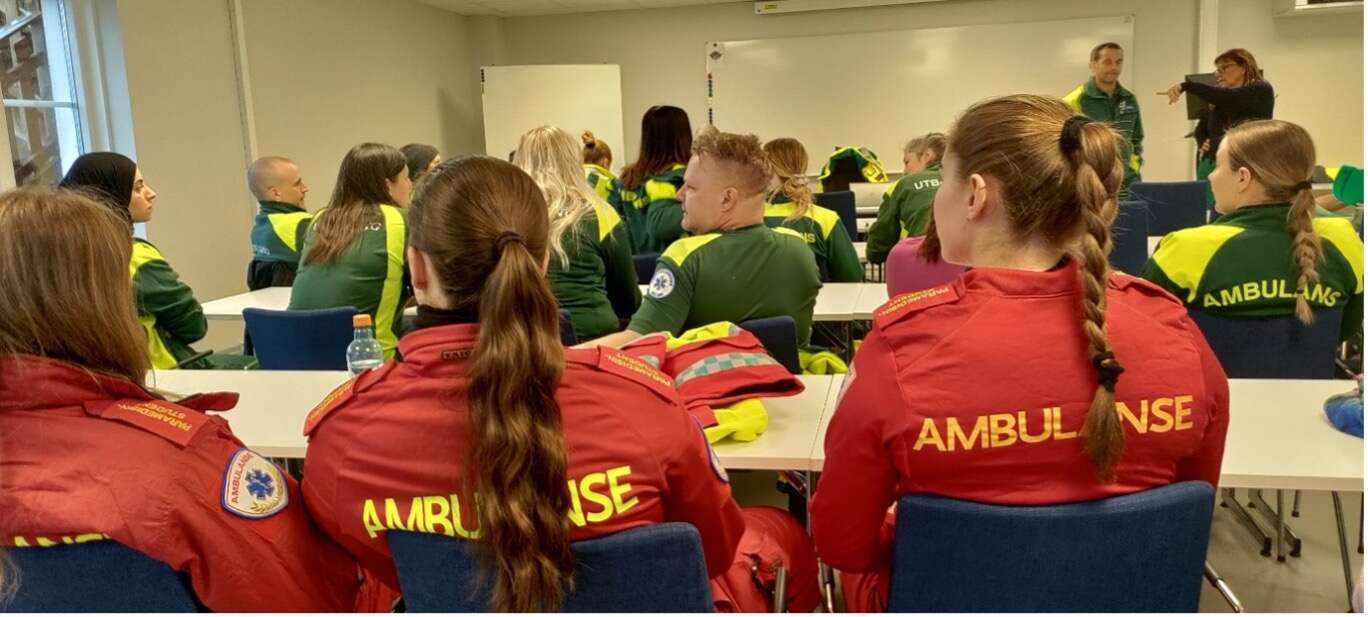
Building such a foundational collaboration covering our Northern countries has been achieved through student and faculty exchanges and rotating turns hosting “international networking weeks”, where faculty and students learn together from our degree programs. These weeks have often ended with the age-old “we share the same challenges and do the same things, just a bit differently” adage. This hits the points made earlier on common challenges. The NordParamedic network has thus uniquely positioned itself to translate the earlier described patchwork into an intentional Nordic “family” of comparable bachelor-level paramedic education, rather than parallel and incompatible systems.
One of the more significant outputs of the NordParamedics network was the Erasmus-funded project European Paramedic Curriculum, or EPaCur. (Dúason et al., 2021). This project (2019-2022) brought together network partners to sketch a common Nordic curriculum language, with potential to broaden to a European scale. Led by University of Akureyri, with Arcada UAS, OsloMet, and EMS Copenhagen from Denmark, EPaCur aimed to design “a model bachelor curriculum” (Dúason et al., 2021). The EPaCur project explicitly argued that the current variation in paramedic education is problematic for mobility, quality assurance, and shared professional identity (Dúason et al., 2021).
By collating data on national laws, regulations, educational practices, curriculum content, and through definition changes, moving from “curriculum” towards competency framework (due mostly to the challenges stated earlier in the text) the EPaCur project finally ended up delivering a harmonised exemplary framework. It became a blueprint that defines what a bachelor-level paramedic education should strive to achieve within the European borders (Dúason et al., 2021). It should also be mentioned that although EPaCur cannot take full credit for Denmark (Absalon) later starting up their paramedic degree, the project output was apparently helpful as part of that argument. As such, through the EPaCur project, the NordParamedics network proved that Nordic collaboration on educational unity is not a utopian dream but an already-existing impactful reality.
Nordic paramedicine is stronger through collaborative research
The Nordic countries’ paramedicine profession has gradually moved towards high-level, research-focused professionalism. Paramedic-led projects and publications are increasing, as we are seeing more graduating paramedics with master’s and doctoral degrees (Paramedic PhD, 2026). This is a sign of our profession carving out its scientific space also in the Nordic countries. In Finland, the Ministry of Social Affairs and Health has now initiated preliminary work on a national prehospital strategy (Ministry of Social Affairs and Health, 2025). This might also have an impact on long-term research strategic focuses in Finnish paramedicine. Meanwhile, the increasing importance of research networks has become evident.
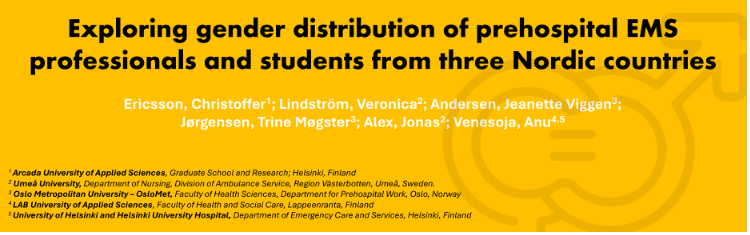
One such network, among others, is the EmCare research network, a small emergency care research group, headed by researchers from University of Umeå and including members from Finland. Such underlying Nordic research networks have paved the way for meaningful collaborative research in, among others, under-researched areas, such as gender inequality in Nordic ambulance services (an ongoing EqualEMS application, by the GENUS research group; see below).
All these are positive trends for the development of paramedicine as a rising autonomous profession. Systematic cross-border collaboration around education and research, specifically shaped by paramedics, is needed. Otherwise, the risk becomes a profession led by others, different and nontransparent qualification ladders, and disparate scientific knowledge spread across our (undeniably small) geographic area. In this time and age of a growing profession and geopolitical needs for collaboration, that is not an option; we need a unified Nordic direction of paramedicine.
A strong constellation of Nordic paramedic networks could well, as we have shown here, turn our diversity into a strategic advantage, by jointly defining relevant Nordic benchmarks of education and research, facilitating mutual recognition, and co creating shared standards for both bachelor and masters-level education levels, as well as future scientific research plans and collaborations. Such has already been done for EMS quality indicators (Lindskou & Lampilinna, 2025), and Helicopter Emergency Medical Services (HEMS) operations (Sollid et al., 2024).
It bears reminding that to be actionable, any such networks need to be agile and focused. We cannot aim to have “big generic networks” for all purposes related to paramedicine; that would only bring rigidity and lost opportunities. Rather, we need to find and create networks which are meaningful, with clear focus and manageable sizes. Arcada has shown huge benefits of both language and agility, when it comes to the potential to be centrally involved in such networks. This is an advantage we need to hold on to and invest in with our students. Although, perhaps somewhere in the future, there could be room for the formation of a joint Nordic College of Paramedicine, a steward of Nordic paramedic professionalism and professional identity?
Christoffer Ericsson, PhD, Degree Programme Director of Emergency Lead Master’s Programme
References
Corman, M. K., Phillips, P., & McCann, L. (2025). The future of paramedic education: Problematizing the translucent curriculum in paramedicine. Paramedicine, 22(4), 205–214. https://doi.org/10.1177/27536386251338525
Coyte, B., Betihavas, V., Devenish, S., & Foster, K. (2023). Resilience, posttraumatic growth and psychological wellbeing of paramedicine clinicians: An integrative review. Paramedicine. https://journals.sagepub.com/doi/full/10.1177/27536386231206501
Dúason, S., Ericsson, C., Jónsdóttir, H. L., Andersen, J. V., & Andersen, T. L. (2021). European paramedic curriculum—A call for unity in paramedic education on a European level. Scandinavian Journal of Trauma, Resuscitation and Emergency Medicine, 29(1), 72. https://doi.org/10.1186/s13049-021-00889-z
Ericsson, C. (2025). Morning always comes: Exploring Finnish paramedic professionals’ resilience resources [Doctoral Dissertation, University of Helsinki]. https://helda.helsinki.fi/items/e5538041-4491-463e-9af6-419aad6c65a4
Ericsson, C. R., Lindström, V., Rudman, A., & Nordquist, H. (2022). Paramedics’ perceptions of job demands and resources in Finnish emergency medical services: A qualitative study. BMC Health Services Research, 22(1), 1469. https://doi.org/10.1186/s12913-022-08856-9
Lawn, S., Roberts, L., Willis, E., Couzner, L., Mohammadi, L., & Goble, E. (2020). The effects of emergency medical service work on the psychological, physical, and social well-being of ambulance personnel: A systematic review of qualitative research. BMC Psychiatry, 20(1), 348. https://doi.org/10.1186/s12888-020-02752-4
Lindskou, T. A., & Lampilinna, V. (2025). The nordic and baltic EMS data—Quality indicators and benchmarking 2025. Scandinavian Journal of Trauma, Resuscitation and Emergency Medicine, 33, 174. https://doi.org/10.1186/s13049-025-01488-y
Makrides, T., Ross, L., Gosling, C., Acker, J., & O’Meara, P. (2022). From stretcher bearer to practitioner: A brief narrative review of the history of the Anglo-American paramedic system. Australasian Emergency Care, 25(4), 347–353. https://doi.org/10.1016/j.auec.2022.05.001
Makrides, T., Smith, F., Ross, L., Gosling, C. M., Acker, J., & O’Meara, P. (n.d.). No Two Systems Are the Same: Paramedic Perceptions of Contemporary System Performance Using Prehospital Quality Indicators. Cureus, 15(3), e35859. https://doi.org/10.7759/cureus.35859
Mausz, J., Donnelly, E. A., Moll, S., Harms, S., & McConnell, M. (2022). Role Identity, Dissonance, and Distress among Paramedics. International Journal of Environmental Research and Public Health, 19(4), 2115. https://doi.org/10.3390/ijerph19042115
Ministry of Social Affairs and Health. (2025, December 15). Kansallisen ensihoitostrategian valmistelu käynnistyy. Sosiaali- ja terveysministeriö. https://stm.fi/-/kansallisen-ensihoitostrategian-valmistelu-kaynnistyy
Paramedic PhD. (2026). Paramedic PhD | Doctorate Register. https://www.paramedicphd.com/registers/doctorate-register
Polat, M., & Köse, G. (2025). Evaluation of paramedics education in emergency health services. BMC Medical Education, 25, 1649. https://doi.org/10.1186/s12909-025-08268-3
Raub, D., Bentele, M., & Robinson, Y. (2025). European perspectives on pre-hospital interagency collaboration during terrorist incidents: A focus group study. Scandinavian Journal of Trauma, Resuscitation and Emergency Medicine, 33(1), 168. https://doi.org/10.1186/s13049-025-01482-4
Sollid, S., Björkman, J., & Kuisma, M. (2024). HEMS in the Nordics—Future research needs high standards. Acta Anaesthesiologica Scandinavica, 68(10), 1289–1290. https://doi.org/10.1111/aas.14524
Strobel, J., Rognås, L., Steen, E., Reis Miranda, D., Schwietring, J., Reifferscheid, F., Böbel, S., & Rehn, M. (2025). Same standards - different outcomes? Why clinical governance is essential to safe and consistent high-quality patient care. Scandinavian Journal of Trauma, Resuscitation and Emergency Medicine, 33(1), 99. https://doi.org/10.1186/s13049-025-01421-3
Tanninen, A., Kouvonen, A., & Nordquist, H. (2025). Competence expected from advanced-level paramedics by emergency medical services managers in Finland: A modified Delphi study. Scandinavian Journal of Trauma, Resuscitation and Emergency Medicine. https://link.springer.com/article/10.1186/s13049-025-01384-5
Health and Welfare
Welcome to the Health and Welfare blog where Arcada researchers, teachers and students write about topics related to education, research, development and innovation at Arcada.
