Vision Work in Times of Change

The year 2024 for Arcada was marked by continued engagement with the surrounding society, both nationally and internationally. Global challenges and societal shifts shaped the landscape for higher education, influencing Arcada’s daily operations.
Issues concerning democratic values, peace and security, as well as the future of the rule of law and the welfare state, were central to public debate. Political developments, with a clear shift to the right and elements of protectionism, along with a series of natural disasters and the ongoing war in Ukraine, contributed to a growing sense of uncertainty—even in Finland. Despite this, Arcada continued to work with a forward-looking perspective.
The country’s economic recovery was delayed, and expectations of extensive austerity measures characterised much of the public sector during the year, including the education sector. In this changing landscape, Arcada’s operations were shaped by both predictable and unexpected events. Arcada repeatedly had to rely on its flexibility, adaptability, and long-term thinking.
New Strategy Paves the Way – Focus on Three Key Development Areas
The year began with intensive preparations for a new agreement period with the Ministry of Education and Culture, including negotiations forming the basis for the new four-year agreement.
Ahead of the negotiations, Arcada, like other higher education institutions, updated its strategy – this time with a perspective extending to 2035. The new strategy was developed through thorough analysis and extensive scenario work, providing a solid foundation for future priorities.
The strategy builds on previous directions but refines the vision further:
“In 2035, Arcada is an educational institution that recognises the strength in diversity. We apply science and research while encouraging commitment to sustainability and a good life. We pride ourselves on being an international higher education institution rooted in the Nordics with a strong focus on research and development.”
To realise this vision, Arcada focuses on three strategic development areas; Growth through strategic internationalisation, enhanced research profiling for competence and quality, societal engagement and impact to promote education. These areas form the foundation for Arcada’s continued development and positioning in a rapidly changing world.
Strategic Internationalisation – International Profile with Local Roots
Arcada is already one of the most international universities in Finland – a strength that will continue to be developed and deepened. A clearer international profile also creates opportunities to strengthen the entire Swedish-speaking education sector in Finland. Key components in this area are integration and inclusion, based on the idea that diversity is a resource and a prerequisite for sustainable development.
Alongside strong support for diversity and equality, Arcada also aims to contribute to the national knowledge boost. This is reflected in the increased degree targets agreed upon for the upcoming agreement period—a sign that Arcada is ready to take its share of national responsibility in meeting future competence needs.
Impact through Education and Societal Engagement
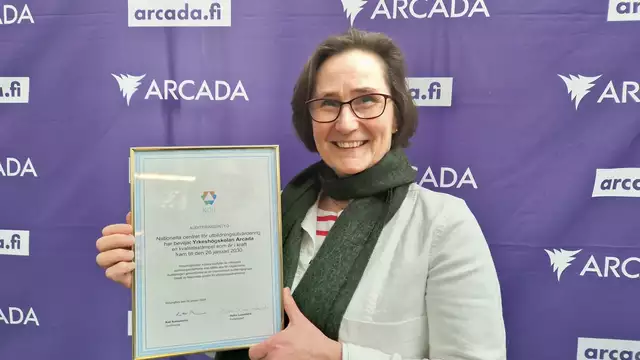
During the year, Arcada took important steps to further strengthen its role as a socially engaged and future-oriented higher education institution. A comprehensive update of the degree programme curricula was carried out in line with the new strategy and in accordance with recommendations from the NCU’s evaluation of Arcada’s quality system. A key focus was deepening the integration between education, working life, and RDI (Research, Development, and Innovation) activities, thereby enhancing the relevance and impact of the programmes.
At the same time, the Arcada intensified its efforts in continuous learning. A roadmap for development was established during the year, aiming to offer a more balanced and needs-based range of continuing education courses. Preparations for Arcada’s adoption of the national platform opin.fi continued as planned.
In summary, the 2024 operational year represented both an end and a new beginning. The final year of the previous agreement period concluded successfully, with Arcada achieving the agreed goals with the ministry as far as possible.
A Strengthened RDI Profile as a Driver of Development
The development of Arcada’s RDI activities continued during the year. The project portfolio was broadened, and project management and follow-up were further systematised. Strategic efforts to further profile RDI activities continued with new routines for project planning and coordination of larger interdisciplinary initiatives. The design of more long-term research programmes and their operational models began but was not yet completed during the year. Models to increase corporate funding and participation in RDI projects were being developed for implementation in 2025. The need to more clearly link education and research with collaboration in working life is a guiding principle embraced by both the strategy and the ministry.
4Q – Strategic Collaboration at the National Level
A new strategic collaboration was initiated with three other universities of applied sciences in Finland—DIAK, Humak, and Kajaani University of Applied Sciences—within the framework of the new agreement period. The collaboration aims to jointly develop identified focus areas. Plans include creating smooth study pathways between the four UAS’, exploring opportunities for collaboration in IT services and other support functions, and developing a new model to highlight and monitor impact. Arcada’s specific responsibility in the collaboration is to lead a joint initiative on internationalisation, focusing on ethical recruitment and models for inclusion and integration of international students.
Conclusion
In summary, the 2024 operational year represented both an end and a new beginning. The final year of the previous agreement period concluded successfully, with Arcada achieving the agreed goals with the ministry as far as possible. At the same time, the year was marked by preparations for the new agreement period, with its exciting new collaborations and performance expectations. Despite global events and national economic challenges, the UAS continues to see its important role as a Swedish-speaking educational institution in the capital – knowing that focus and profiling will be necessary in everything it does moving forward.
23 June 2025 in Helsinki
Mona Forsskåhl