Collaboration with working life is key in changing times

In 2025, collaboration with external partners continued to play a crucial role in Arcada’s research, development and innovation (RDI) activities. In a time marked by global uncertainty, rapid technological advancement and growing demands for sustainable solutions, collaboration between higher education institutions and the working life is becoming increasingly important.
Increased collaboration throughout the year meant that researchers, students and project partners worked together to develop knowledge that could be put into practice.
'As a university of applied sciences, we have always worked closely with the business community. That is where we see what skills are needed and how industries are changing. When research, development and innovation (RDI) meet the business community, we can develop solutions that both strengthen industries and make a real impact,' says Carl-Johan Rosenbröijer, responsible for strategic business relations.
Over the course of the year, collaboration with the business community has led to tangible results – from new sustainable materials to digital solutions for early years education.
From the Baltic Sea to the cleaning cupboard
As part of the BalticReed project, Arcada has collaborated with the company Sinituote to develop new sustainable material solutions. Together with Sinituote, Arcada researchers have developed something unique: a shaft holder made from reed composite – a mixture of ground reed from the Baltic Sea and plastic. The reed is harvested from the coastal waters of the Baltic Sea, where it would otherwise contribute to eutrophication. By utilising it, nutrients are removed from the coastal ecosystems, whilst at the same time we obtain a sustainable material that can replace fossil-based plastic.
'This is the result of combining research, innovation and environmental benefits through close collaboration between researchers, engineers and product developers from Sinituote,' says Laura Montin, environmental specialist and project manager.

Digital solutions for early years education
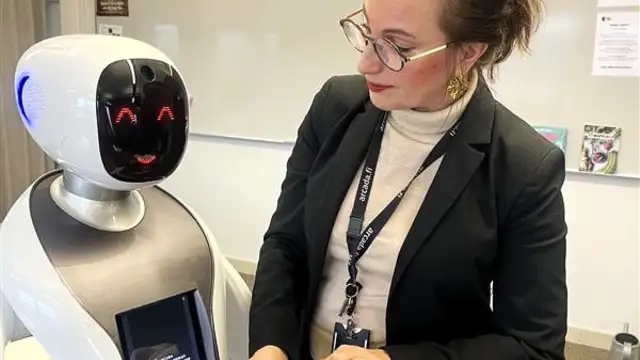
More than ten years ago, Arcada began conducting research into AI (artificial intelligence) and pioneered the field. In recent years, Arcada has further refined its focus in AI research by concentrating specifically on ethical issues related to new technologies and on human-robot interaction. In 2025, this work was intensified through the BARTEK project, which aims to contribute to a better understanding of how social humanoid robots can complement and facilitate a safe learning environment in Swedish-speaking daycares in Finland.
The project aims to help develop the university’s Swedish-language social work programmes and continuing professional development so that they also encompass the use of digital tools.
'In other words, we aim to contribute to a sustainable knowledge boost in the field. Ultimately, the project is expected to lead to Swedish-speaking daycare staff gaining increased knowledge and understanding of how digital solutions can be integrated into daily operations, in line with the National Agency for Education’s plan for early childhood education,' says Christa Tigerstedt, principal lecturer in business administration and project manager.
The project is being carried out in collaboration with around ten Swedish-speaking daycares in the capital region.
In 2025, around ten new projects were launched that have a direct link to the world of work.
'When we work on projects in close collaboration with the world of work and focus on application, the solutions can be put into practice relatively quickly,' concludes Rosenbröijer.
RDI 2025 in figures
- Number of publications: 164 (2024: 217), of which 48 (2024: 79) resulted from international collaboration
- External RDI funding: 2,4 million euros (2024: 2 million euros)
- Number of researchers: 82 (2024: 127 which includes actors appearing in Arcada productions – a figure that has been excluded for 2025