Arcada launches English-language IT courses

The engineering programmes at Arcada University of Applied Sciences continue to evolve to meet the needs of the future. As part of this initiative, an English-language programme in information technology was launched in 2025.
At the end of August 2025, nervous yet excited students on the Information Technology (IT) course gathered for the first time during the orientation days on campus. The new English-language bachelor’s programme has been a long-awaited addition.
– Nordic higher education programmes have long been popular internationally, and for several years there has been talk here of launching an English-language IT programme to complement the Swedish-language one. With the curriculum due for renewal in 2025, the time had finally come,” says Fredrik Welander, Head of Information Technology at Arcada.
The English-language IT programme is still in its early stages and will grow as a new cohort of students is admitted each year. According to Welander, the programme already has clear strengths:
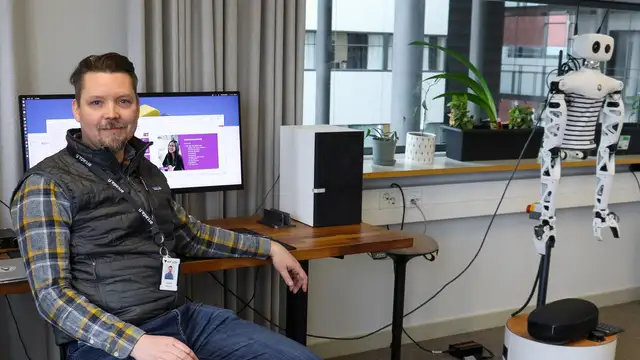
– In my view, a key strength is that we are good at combining theory with practice. The new specialisations, Data Processing and Analytics and Intelligent Robotics, will be excellent additions that both broaden our offering and provide students with better opportunities to delve deeper into a subject that interests them, he says.
Cross-linguistic collaboration
To ensure the relevance of the programme, there is an industry advisory board that regularly brings together representatives from the business community, and guest lecturers are invited through the university’s own networks. Arcada also participates in the EU-funded Anchor project, which specifically supports international students in establishing links with the world of work for internships and future employment.
– The needs of the labour market have a significant impact on the programme, and the aim of the curriculum design is, of course, to ensure that our graduating IT engineers are well-equipped to succeed in the labour market. This applies equally to the Swedish-language and English-language programmes, says Welander.
Cooperation between the two programmes is close. Apart from the language of instruction, the programmes are largely identical, and all courses, with the exception of language courses, are offered within both programmes. Some courses are run entirely jointly, whilst others have occasional joint lectures or practical sessions.
– Joint activities also help our international students to make contacts and give them a better chance of finding work later on and integrating into Finnish society, says Welander.
Teachers are a key resource
Arcada’s engineering lecturers play a central role and are often praised for their dedication and approachability. In a smaller university, the barrier between students and staff is lower, which fosters close dialogue and contributes to a supportive learning environment. This is also reflected in the students’ achievements.
Among them is Mahesh Viyannalage, a student on the Mechanical and Sustainable Engineering (MSE) programme, who came second in NASA’s international Lunar Rescue System Challenge.
– I am truly grateful to the academic staff at Arcada. Thanks to their guidance, I gained practical experience and learnt many important principles of design and simulation. Without their support, I don’t think I would have been able to complete this invention in the way I did,” he says.
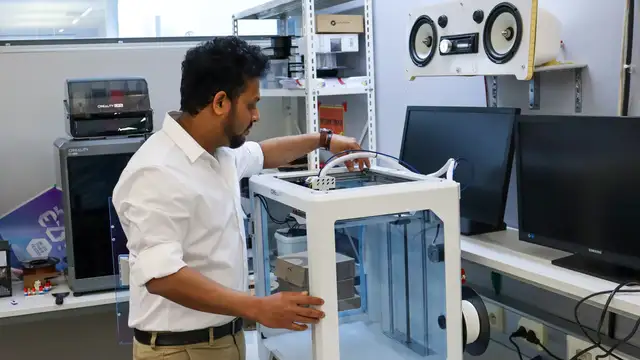
Another engineering student who stood out in 2025 is Madumalie Athukorala Dona. She was awarded the Women Academics in Helsinki Association scholarship for her outstanding academic achievements.
“I feel very fortunate to be studying in an environment where I am always encouraged to aim higher. The support from the teachers goes beyond teaching; they really inspire students to realise their dreams,” she says.
I feel very fortunate to be studying in an environment where I am always encouraged to aim higher.
MSE student Anton Truss also achieved success during the year. Truss was the youngest participant selected to take part in the RACE 2025 competition, a European competition for innovation in the steel industry, where his team finished in third place.
The common thread running through these success stories is the support and encouragement provided by the teachers. Welander cannot pinpoint any single reason why Arcada’s teachers are particularly appreciated by the students.
“I think most of them enjoy their jobs and the contact with the students, and I believe that is a key prerequisite,” he says.