Arcada's nursing programme – guided by heart and head

For the third consecutive year, Arcada’s nursing programme was voted the best in Finland by graduating students in 2024. What are the key factors behind the success of this popular programme, and how has it evolved over time?
“‘I promise to serve life and health, to alleviate suffering, and to safeguard human dignity, in a spirit of love.’”
These are the opening words of the nurse’s pledge, recited by students who have trained as nurses at Arcada University of Applied Sciences.
Arcada began training nurses in 1996, and over the past three decades, the programme has undergone significant development.
“In the past, studies were more specialised, with nurses focusing on areas such as internal medicine, surgery, or psychiatry. Today, those specialisations have been phased out in favour of a broader, more comprehensive nursing education totalling 210 credits. We’ve also added more general courses, such as languages,” explains Jari Savolainen, lecturer in nursing at Arcada.
The nursing degree is also integrated into Arcada’s other healthcare programmes—midwifery, first aid, and public health nursing—where graduates earn a double degree.
“Our healthcare programmes are closely connected to working life through projects and placements, which naturally makes it easier for students to find employment after graduation. It also opens up a wide range of future opportunities,” says Savolainen.
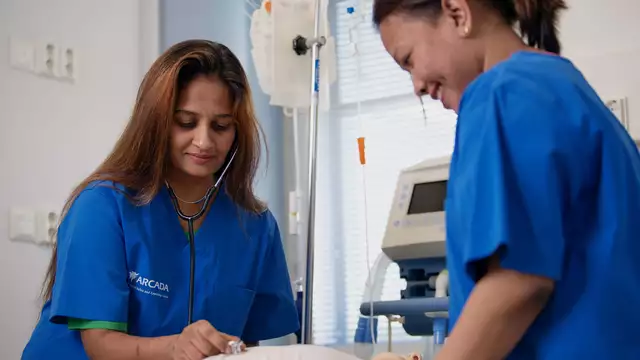
Nursing students at Arcada University of Applied Sciences.
With Head, Heart, and Hand
Although the nursing programme at Arcada has undergone significant changes over the years, one central theme has remained constant, says Maria Appelroth, Senior Lecturer in Nursing and Degree Programme Directors for the Swedish-language nursing programme at Arcada.
“The ethics of nursing and patient care are at the core of our programme. How we treat patients is fundamental to nursing and something we hold in high regard. It’s about truly seeing and listening to patients, especially when they find themselves in vulnerable situations,” Appelroth explains.
This emphasis on empathy and ethical care is also highly valued in the professional field.
“We regularly receive feedback that our students excel in patient interaction - and we’re very proud of that,” she adds.
Critical thinking is another vital aspect of both the nursing profession and the educational approach at Arcada. This is why the role of the nurse is often symbolised by the trio: head, heart, and hand.
“The heart represents empathy, the head stands for reflection and critical thinking, and the hand symbolises the practical skills developed through clinical exercises, simulations, and hands-on experience during practical training. Together, they provide a strong foundation for professional nursing practice,” says Appelroth.
A Human-Centred and Empathetic Approach
In 2024, Arcada’s nursing programme was voted the best in Finland by students—for the third consecutive year. According to the AVOP survey conducted in 2023, the programme received an impressive average score of 5.98, compared to the national average of 5.27. Students particularly appreciated the support services, course content, and quality of teaching. Opportunities for simulation and hands-on training were also highly valued. The sense of community, small group sizes, and a supportive learning environment are key strengths of the programme.
“Arcada is a small university of applied sciences, which fosters a close-knit community between lecturers and students. This enables personalised guidance and tailored teaching. We genuinely want to get to know our students, and that creates a supportive and inclusive learning atmosphere,” say Jari Savolainen and Maria Appelroth.
The programme’s core values are also reflected in its teaching methods.
“We aim to be student-centred and promote self-directed learning. Students take responsibility for their own development, while we as educators facilitate that process. Our role is to create environments - both physical and social - that support learning. By adopting a human-centred approach to education, we hope to inspire students to apply the same mindset in their patient care,” says Appelroth.
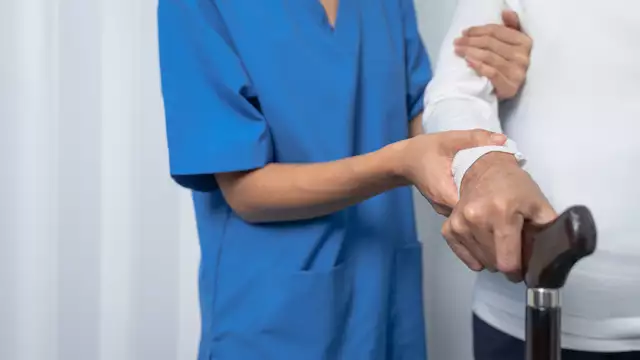
Nursing students at Arcada University of Applied Sciences.
International Education Highly Valued
It’s not only the Swedish-language nursing programme that receives high praise. Since 2011, Arcada has offered international nursing programmes in English. In 2019, supplementary TopUp programmes were introduced for nurses who have already qualified abroad. In the national comparison published in 2024, the international programmes achieved record-high ratings.
“The flexibility of these programmes is especially appreciated by students—particularly those in the TopUp programme, as it allows them to continue working while studying,” says Terése Sjölund, Senior Lecturer in Nursing and Degree Programme Director for Arcada’s nursing programmes.
Student support is another highly valued aspect, contributing to the programme’s strong reputation.
“We receive a lot of positive feedback for helping students find employment during their studies. For example, we organise online networking events where employers and trade unions present job opportunities. These often lead to summer jobs and, eventually, permanent positions,” Sjölund explains.
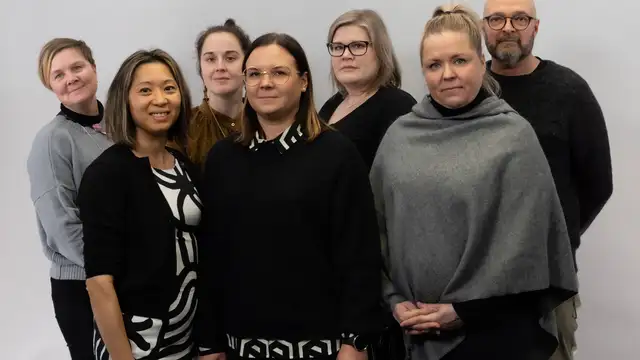
The team for Arcada's Nursing- programmes. From the left; Terese Sjölund, Pauleen Mannevaara, Ann-Mari Pohjola, Lotta Eronen, Mikaela Lindqvist , Niina Lempinen, Craig Wilkinson
Interest in the English-language nursing programmes continues to grow. In 2024, 56 nurses graduated from the Nursing programme, and 278 TopUp Nursing students began their studies. Through the SaiLa project (Sairaanhoitajan laillistaminen), which provides a pathway to legalised nursing in Finland, seven nurses began their studies in June 2024.
Terése also hopes to integrate international and Swedish-language teaching more closely in the future.
“This would help students learn to collaborate in Finnish—the common working language in healthcare in Finland, which is essential for anyone wishing to work in the sector.”.
Looking Ahead: The Future of the Profession
The vision for increased collaboration is shared by Degree Programme Directors across the national programme. They also hope that more flexible study options will attract additional students to the Swedish-language programme.
“We want to continue drawing people to the profession and explore new teaching formats that suit students’ individual circumstances—such as combining studies with work, which can be supported through distance learning. Naturally, we’re also keen to explore the possibilities offered by new technologies,” says Appelroth.
Setting realistic expectations for the profession is equally important.
“We acknowledge that the healthcare sector can be challenging. That’s why we emphasise the importance of self-compassion. Building personal resilience is crucial to being able to care for others,” Appelroth notes.
“Overall, our students are very reflective. They think deeply about the situations they encounter during placements—how those experiences affect them, and why they chose this field. We often hear from employers that younger nurses bring positivity, hope, and a renewed sense of purpose to the profession.”
Developing a strong professional identity remains a key goal for the programme.
“We want Arcada nurses to continue recognising the importance and essence of caring. A well-educated nurse with empathy, strong clinical skills, and capable hands. Most importantly, we want our nurses to remain proud of their profession—because they truly should be,” says Savolainen.
Read more about:
- Arcada's swedish nursing programmes: https://www.arcada.fi/sv/studera-pa-arcada/bachelorutbildningar/sjukskotare (in swedish)
- Arcada's Nursing Top-Up programme in english: https://www.arcada.fi/en/study-arcada/b…